Thursday, October 4, 2012

Halloween Holocaust: A Study in Terror (James Hill, 1965)


I was unfamiliar with this seemingly overlooked mid-sixties gem until very recently, when it aired on late night TV, and after watching it a few nights back, I now consider this a frankly criminal oversight. Whilst not a horror film in the traditional sense, it arguably skirts the edges of the genre, as great thrillers often do; obvious examples that spring immediately to mind include a lot of film noir, some Hitchcock classics and the gialli of Bava, Argento, Fulci and others.


It was only a matter of time before someone decided to pit the world's greatest detective (well, tied with Batman at least) against, quite possibly, the most infamous villain in the annals of criminal history, Jack the Ripper. Indeed, there was apparently a Spanish language Holmes pastiche entitled Jack el Destripador that appeared not long after the murders. This literary flight of fancy would obviously not be a singular occurrence; on the contrary, it has inspired many writers, filmmakers, and even video game makers over the years. 


This particular filmic incarnation of the idea is especially intriguing in that it suggests elements (albeit as fictional grist for the mill, as opposed to serious speculation regarding the real murders themselves) of the Royal Masonic conspiracy, later theorised by Stephen Knight in his highly controversial (and now largely discredited) 1976 book, Jack the Ripper: The Final Solution, which itself would later form the basis for what is arguably Alan Moore's magnum opus, From Hell (original series 1991-1996; collected edition - 1999). Also, it would be used again in a later film, Murder by Decree (1976), directed by Bob Clark (director of the seminal, pre-Halloween slasher, Black Christmas) and featuring Christopher Plummer as Holmes and James Mason as Watson. 


A Study in Terror stars John Neville (probably best known for playing the title role in Terry Gilliam's The Adventures of Baron Munchausen)  as the superlative sleuth and Donald Houston (Clash of the Titans) as his ever faithful friend. Robert Morley (the guy with the poodles from the brilliant Vincent Price vehicle Theatre of Blood) is delightful as Sherlock's long suffering brother Mycroft, although he is sadly somewhat underused. Also, keep an eye out for appearances from the young Barbara Windsor and Judi Dench. 


I won't attempt to provide a detailed synopsis of the film as it's sufficient to know the initial setup, already detailed above. As far as I can tell based off my first viewing, the plot seems to be scrupulously constructed (i.e. watertight and lacking holes), and the various deductions Holmes makes are brilliantly elucidated by the writers, Derek and Donald Ford. In fact, whilst I would say that all involved (both cast and crew) collectively and consistently deliver the goods throughout, it was the quality of the writing that stood out for me as the film's greatest asset.


What also makes the movie highly enjoyable is its rich mix of horror, intellect, action, pathos and humour. Some of the murder set-pieces are cleverly staged, using simple elements like water and red-lighting to quite startling effect. At one point, our dynamic duo get to engage in a bit of the old fisticuffs in a back alley scuffle with some hooligans; amazingly, Sherlock manages to keep his top hat on throughout the entire thing. And there are moments that frankly made me laugh out loud, such as when Holmes and Watson go to the pub, dressed to the nines. The landlord, spotting that they're obviously loaded, doesn't think twice about pushing a semi-conscious patron off his chair to make room for these apparent high rollers. 


Finally, the production design, as is to be expected with a film of this vintage, is the studio-bound, dry-ice gothic familiar to many Hammer productions; needless to say, it conjures both the ideal atmosphere for a cinematic interpretation of a Ripper story and some appropriately autumnal ambience for an October evening's viewing. Holmes fans unfamiliar with this title should seek it out immediately.   


Wednesday, October 3, 2012

Halloween Holocaust: Double Feature: Re-Animator/From Beyond (Stuart Gordon, 1985/1986)


This mid-80s H.P Lovecraft inspired double-header can easily be considered as a pair of the ballsiest and most far-out horror adaptations ever made. As shown by masters of cinema such as Alfred Hitchcock and Stanley Kubrick, it matters not if your story is borrowed from elsewhere; it's what you do with it that counts. Therefore, the most interesting adaptations usually require the input of someone with a strong vision, who can read the source material and refract it through their own unique sensibility. Whilst both films are ensemble pieces through and through (both in front of the camera and behind), I think it's safe to say that director Stuart Gordon qualifies as such a man.  


The Chicago born Master of Horror originally got his start in the theatre, producing such wonderfully subversive fare as an adaptation of Peter Pan inspired by the shenanigans at the '68 Democratic Convention, with Peter and the Lost Boys as a bunch of hippies taking on a Mayor Daley inspired Captain Hook. Best of all, the trip to Neverland was apparently a lysergic one. Perhaps unsurprisingly, the authorities and the public were appalled, leading to the whole affair becoming a national controversy and, word has it, causing Gordon and his future wife to be arrested for obscenity (the charges were later dropped). As you might expect then, this is exactly the sort of guy you could reliably put your money on to make a balls-out, pull-no-punches horror flick, which is exactly what then neophyte producer Brian Yuzna (director of 1989's brilliant splatter-satire Society) did when he and Gordon first met. With assistance from writers Dennis Paoli and William J. Norris, the pair would go on to craft an unforgettable, visceral, cinematic one-two punch with their debut and sophomore efforts.


Both films essentially concern Promethean scientific research gone awry (i.e. the whole "humans weren't meant to meddle with such things" story), caused by irresponsible and/or amoral scientists. Intriguingly however, the character dynamics presented in Re-Animator are later reversed in From Beyond, with Jeffrey Combs's reckless scientist from the former becoming a well-meaning and cautious unfortunate in the latter and Barbara Crampton turning from the victim in the first film to borderline antagonist in the second (she certainly helps to catalyse coming events, at any rate).

One of the things that makes these films both unforgettable in their own right and somewhat atypical as Lovecraft adaptations is how they co-mingle the horrific, the comedic and the erotic, to create situations and imagery that you can't quite believe you're seeing at first, perhaps due the relative anemia of the majority of routine genre fodder. 


A thick vein of black humour runs through both titles in varying degrees, but I'd say that From Beyond veers closer to pure horror, where as Re-Animator manages to maintain a fairly consistent balance between the funny and the frightening throughout almost its entire run-time.                  


On the acting side, credit is also due to Bruce Abbott and Dawn of the Dead's Ken Foree, who serve as believable and likable audience surrogate characters in their respective films, and David Gale and Ted Sorel who play the two movies' creepy, power-hungry antagonists. The production values, especially the cinematography, gore effects and music, are uniformly top-drawer; much of the same talent worked on both pictures.


Needless to say, if you're a fan of the genre, or not easily shocked and looking for something out of the ordinary, check either (or ideally both) of these films out immediately. Just don't let your grandmother watch them, as she'll no doubt be appalled, if she doesn't have a heart attack first, of course.

Tuesday, October 2, 2012

Halloween Holocaust: Idle Hands (Rodman Flender, 1999)


This modest, but entertaining and well executed horror comedy gem apparently flopped when it was first released. The general consensus for what caused this, although admittedly impossible to prove, is widely held to be its ill-timing; it was released just ten days after the Columbine High School massacre. Admittedly, the film isn't a masterpiece (well, to me at least anyway), and there are, to be honest, some parts where I always end up thinking "I should really stick Evil Dead II on right now" whenever I watch it. Nonetheless, it still scores highly as one of those familiar but always reliable flicks to dig out whenever the Halloween season comes around; I'd say that it fairly well fits Quentin Tarantino's definition of a good hangout movie (to give an example, if you're unfamiliar with the term, QT considers Richard Linklater's Dazed and Confused as possibly the greatest film of this type).


The story follows Anton Tobias (the excellent Devon Sawa, who also starred in Final Destination), a lackadaisical stoner (not that I've got room to judge) whose chronic (or should that be chronic fuelled?) laziness leads to him becoming a magnet for a discarnate, malevolent force that possesses one of his hands, turning him, in the process, into the proverbial "Devil's plaything". He's assisted throughout this troublesome episode by his perennially toasted buddies Mick (Seth Green) and Pnub (Elden Henson) and the smoking hot, bass playing chick from across the street, Molly (Jessica Alba). Also along for the ride, although more intermittently, are fearless Druidic priestess/warrior Debi LeCure (Vivica A. Fox) and truck-driving, Motley Crue fan, Randy (Jack Noseworthy).


Whilst the movie comes down somewhat short on the horror/suspense side of things (although these elements are still reasonably well set-up and staged) it functions perfectly well as a lighthearted comedy romp. You could perhaps try and read into Anton's narrative arc and look for subtext, but I wouldn't bother, as it all feels a little inconsistent (not that it really matters). In fact, it's kind of cool that the film comes full circle in its seeming suggestions about marijuana use; weed actually ends up helping to save the day here (see also - Richard Stanley's brilliant, underrated sci-fi horror Hardware (1990)).  


Other elements worth noting include the film's soundtrack, which features Sublime, Rob Zombie and The Offspring (who also cameo as the band at the school Halloween dance); the occasional visual flair on display (I'm always a sucker for those seasonal coloured lights; green, red and orange gels aplenty here) and the obvious awareness of and reverence for the genre shown by the creators (any film which riffs on both Tenebre and The Shining within the space of, I think, less than a minute, is cool in my book). 


As I've suggested a few times already, this is a pretty light movie, to be sure, but that is, perhaps, precisely the basis of its appeal. As any genre fan surely knows, there are more than enough heavy horror films out there to put you through the proverbial wringer if that's what you're after. If, however, you want to stay within the genre, but remain relatively unscathed (emotionally speaking), then Idle Hands would be an ideal choice for an evening's viewing.  


Monday, October 1, 2012

Halloween Holocaust: Phantasm (Don Coscarelli, 1979)

Note: Inspired by similar shenanigans happening over at Reddit and the Final Girl horror blog, I've decided to attempt my own month long horror viewing spree. Half of the list is set but the other half is still germinating (you'd never guess that this was an 11th hour decision right?). Some of the posts will be linked to discussions occurring on the same day at the one of the aforementioned websites and the rest will be my own personal choices. To get the ball rolling, I've decided to start with one of my all time favourite movies, regardless of genre, Don Coscarelli's cult classic, Phantasm. 


Like many of my favourite horror films, this film has (among other things) two particular qualities which I'm always on the look out for. Firstly, it's suffused with a richly atmospheric, dreamlike feeling, reminiscent of your strangest nightmares. Put another way, it's the kind of movie where, if you came home drunk or stoned late one Saturday night and started watching it in a borderline-catatonic daze before falling asleep, you'd probably be hard pressed upon waking the next day to remember whether it was a film or a dream.


Secondly, it has an unrestrained, everything and the kitchen sink approach to storytelling (or what Guillermo del Toro called the "Why da fack not?" philosophy - in his best approximation of an Italian accent -  when describing the films of Dario Argento); the kind of thing that makes you seem slightly bonkers when you're attempting to give a plot synopsis to the uninitiated. To give you an idea precisely what I mean, I'll briefly summarise the basic premise: a lonely, orphaned teenage boy seeks the assistance of his older, bad-ass, musician brother and an ice cream man (who also plays pretty mean lead guitar) in halting the diabolical machinations of a dimension-hopping, gender-bending undertaker who is killing people, stealing their bodies and turning them into dwarves (who incidentally look like Jawas) before sending them through a star-gate type device to work as slaves on another world. See what I mean? 


Perhaps strangest and most unexpected of all, is that the film works not only as a nutty yet extremely enjoyable B movie, but also succeeds on an emotional level due to its elegiac tone and warmly realised characters (witness the porch jam that Jody and Reggie have early in the film for example; maybe pointless on a narrative level but it's the kind of intimate, naturalistic scene that can make you feel almost instantly bonded with the characters, kind of like you're hanging out with them), who are a far cry from the 2D throwaway cutouts that often populate lesser films of the genre. Credit must go to all the principal actors for providing such memorable performances but perhaps especially so to the then young Michael Baldwin (not that one though) who carries most of the emotional weight of the movie as Mike, and also to the imposing Angus Scrimm as the now iconic Tall Man, who gives a larger than life performance that is almost otherworldly in parts (case in point - the scene next to Reggie's ice cream van).


Also of note is the excellent score by Fred Myrow and Malcolm Seagrave. Like many classic horror soundtracks, especially of this era, it combines traditional, melodic elements and electronic, ambient sound-scaping; an ideal set-up for this film, with its mixture of the melancholic and  the foreboding. 


Don Coscarelli, far from being a one hit wonder, has gone on to be a cult genre figure in his own right, later producing three Phantasm sequels (none of which I've yet seen, criminally), the Bruce Campbell starring cult favourite Bubba Ho-Tep (2002) and the recent John Dies at the End (2012), an adaptation of David Wong's novel that's been garnering great reviews since its release. Let's hope that the money men continue to give him the funds to make even more wonderful, unique movies like all of these, but especially Phantasm.


Thursday, September 6, 2012

Saturday Matinee Double Bill: Go West (Buster Keaton, 1925) & Go West (Edward Buzzell, 1940)

Preface: I’m sure anyone reading this has already deduced the fact that updates to this blog, if they occur at all, may be extremely sporadic. However, having said that, I’ve recently had the blogging bee buzzing round my bonnet again, whispering sweet nothings to me, so it could go either way.

For a reason that currently escapes me, I’ve recently gotten into the habit of watching a lot of double features at home. I think part of it stems from my occasional inability to figure out what I want to watch next (with there being so much to choose from these days). By having theme nights or employing some kind of six degrees of separation process for linking films together (in ways ranging from the obvious to the more outré) I’ve found this has become less of a problem and has actually made the process of figuring out what to watch during a given period kind of fun in itself.

Also, being born during the VHS era, I sadly missed out on the golden age of repertory cinemas/revival houses that used to programme these things all the time. Certain theatres in the UK’s larger cities still do these sorts of events occasionally but I am unfortunately a fair distance away from most of them. Needless to say, the obvious solution was to try to approximate the experience at home. Sure, it isn't nearly the same, but it does have its positive points (the main one that comes to mind is being able to have intermissions anytime one feels like it).
        
Finally, from the critic’s point of view, watching a few films in succession, whether they are linked in some way, or wildly divergent, often brings some interesting and occasionally unexpected things to light.

Most of the double-bills I’ve watched have tended to be of horror movies but for the first of these little comparative critiques I’ve picked a couple of comedy-westerns. And as anyone who’s awake will have already noticed, neither of them is Blazing Saddles, surprisingly.


Aside from their shared title and setting, the first thing that occurs to me when considering both of these movies in tandem is that, delightful as they are, neither are generally considered top drawer stuff from their respective creators. However, as James Agee pointed out in his review of the Marx Brothers’ later film A Night in Casablanca (Archie Mayo, 1946): “the worst they might ever make would be better worth seeing than most other things I can think of.” I’d have to say I wholeheartedly agree and that personally I also find this to be the case with Buster Keaton.

As per usual, we find Buster, at the beginning of his film, down on his luck and on the move to what he hopes will be greener pastures. His protagonist, the characteristically named Friendless, gets off to a shaky start. Firstly, he pawns all of his possessions and becomes almost instantly broke again after having to buy some of them back and then, whilst attempting to find work in the city, he’s trampled under foot by cold, self-absorbed pedestrians. Understandably depressed about how all this is going, Friendless slumps down and takes a seat on the side of the train tracks to reassess the situation when he has a vision of Horace Greeley’s statue (seen at the film’s start) imploring him to “Go West, young man”. Things have come to a dead end in the city so he decides to heed the ethereal statue’s advice.


Sadly, the residents of the ranch that Buster eventually arrives at don’t seem to be much warmer than their urban counterparts. Sure, they give the little guy a job but they still act somewhat chilly towards him (the recurring scene where they all seem to finish dinner the second he sits down at the table springs to mind) and some are just downright mean to him on occasion (he’s nearly gored by a bull after being told to wave something red at it by mischievous cowboys).  

However, a ray of sunshine eventually appears on this somewhat cold and desolate horizon in the form of a cow called Brown Eyes. They become fast friends after Friendless extracts a rock from her hoof, thus curing a limp and later, somewhat returning the favour, she saves him from being gored by yet another bull. As one might imagine though, things eventually conspire to drive Buster and his new bovine buddy apart.


Whilst the film is perhaps not as thrilling and certainly less technically audacious than many of Keaton’s more highly regarded pictures (a few stylistic flourishes aside, such as a couple of POV shots from the perspective of various charging bulls, which I imagine would have been pretty damn impressive in 1925), I personally find it to be the most purely heart-warming of them all (there are still a handful of his silents that I haven’t seen yet though). On the surface, you might think that the central premise of what is essentially a love story between a man and a cow could horribly backfire and thereby relegate the film to the realm of novel comedic follies but honestly, if you’re not a little bit moved when Buster attempts to buy Brown Eyes from the rancher (Howard Truesdale) to save her from the slaughterhouse then I’d suggest there might be something wrong with your ticker.


The remainder of the narrative follows Friendless and a train full of cattle bound for the city where they are to be taken to the stockyards and sold in order to save the ranch from bankruptcy. However, following a shootout with some rival cowboys Buster has ended up as the sole shepherd of this particular herd and is forced to guide them single-handedly through the city streets, much to the horror of the residents and local law enforcement. Understandably intrigued by their new surroundings, many of the cattle disperse and go for a sojourn round the shops, forcing Friendless to find some means of rounding them up so they can carry on towards their intended destination. His solution to this quandary consists of donning a red devil costume and letting the herd (who are eventually also joined by the police) chase him, giving us, in the process, one of the most sublimely absurd sequences in Keaton’s entire canon.


The story comes to a typically satisfying conclusion as Buster saves the ranch, wins respect from his peers for his efforts and gets the girl. However, there’s a slight twist in this particular tale which makes it somewhat unique amongst Keaton’s films and, like I said earlier, never fails to warm my heart.


Whilst this isn’t exactly the best film to watch if you’re unfamiliar with silent cinema or have yet to be introduced to the genius of Buster Keaton, I’d still say you can’t go far wrong with it either, as long as you take into account when it was made.

Fast forward to 1940 and we find Keaton - whose star had sadly faded somewhat due to the silent era being superseded by the coming of sound and the creative straightjackets often imposed upon him by MGM (who he signed to in 1928) - working as an uncredited gag writer on the Marxs’ namesake picture. For the most part it’s hard to imagine anything more antithetical to Buster’s relatively slow-burning, predominantly visual, tragi-comic aesthetic than the anarchic and often surrealistic three-ring circus sensibility of the Marx Brothers. Unsurprisingly then, it seems that Keaton’s main contributions to the film were in the form of sight gags for Harpo, the early sound era’s master of pantomime. Whilst it would be interesting to speculate upon the specifics of what Keaton contributed to the picture, the lack of any real documentary evidence upon the matter leaves it somewhat open as a guessing game for fans and scholars to play.  


The plot, as was pretty much standard for the Marxs’ MGM films, follows the brothers as they attempt to help a young couple to thwart the unscrupulous machinations of scheming antagonists. Unfortunately, said couple (again, as is almost invariably the case in the MGM pictures) may well come across, to a modern audience at least, as almost overwhelmingly earnest. Having said that, your mileage may vary and, to be honest, whether I personally find such characters tiresome or not depends mainly on what sort of mood I’m in at the time. Sometimes it seems quite sweet and endearing, other times it feels frankly nauseating (although the same could be said, I suppose, for romance in films generally, both contemporary and vintage).


So, as you might have gathered, the story isn’t exactly this film’s main selling point (although I’d say it’s certainly more engaging in this department than in many of the other post-Thalberg pictures). Thankfully, all the elements that one generally expects from a good Marx Brothers movie are still present and in plentiful supply. For the sake of expediency and ease of reading, here’s a quick list for y’all:

·     Wacky (or in this case suggestively naughty) character names; I’m looking at you S. Quentin Quayle (apparently San Quentin quail is slang for jailbait).


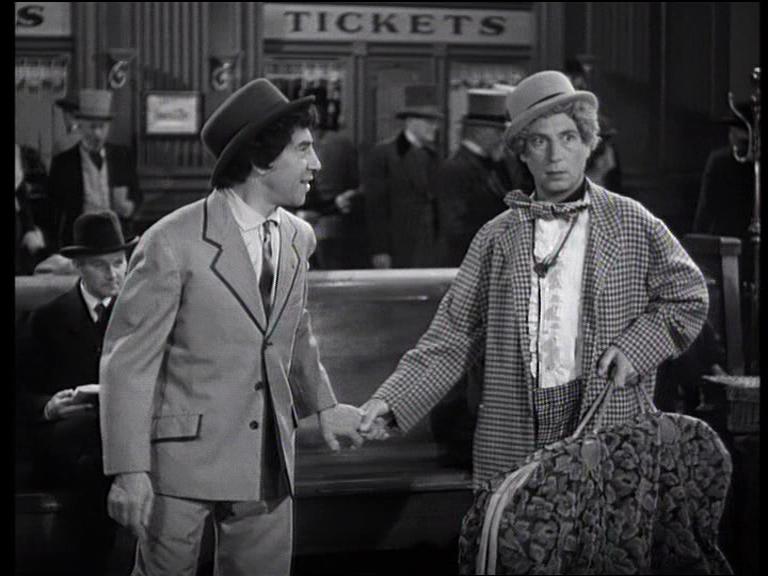
·     Groucho getting royally fleeced by Chico and Harpo. They manage to con him out of all his money at the train station, early in the film. Harpo even ends up cutting his pocket out to help achieve this aim, leading Groucho to announce: “There’s something corrupt going on around my pants but I just can’t seem to locate it”.


·     An obligatory and wonderfully playful piano number from Chico. It occurred to me when re-watching this film recently that Chico’s right hand is almost like a character in itself when he’s playing.


·     An obligatory and completely sublime harp interlude from Harpo. Seeing as such instruments are hard to come by in the Old West, he MacGyvers one out of a loom.


·     Typically chivalrous banter from Groucho: “Lulubelle, it’s you! I didn’t recognise you standing up.”

·     Borderline racist stereotyping edging towards the realms of caricature (not completely uncommon for the period it seems; the infamous (and now censored) black centaur from Fantasia (also from 1940) and the “Who Dat Man?” musical number from the Marxs’ A Day at the Races (Sam Wood, 1937) also spring to mind) during the scene on the Indian reservation which, incidentally, features some of the most unconvincing Hollywood grown Indians I’ve ever seen (although, yet again, this kind of thing is not exactly rare in films of this vintage).


As the above suggests, the plot unfolds in and around the variety show structure that one generally expects from a Marx Brothers’ picture (something that was obviously carried over from their formative days as vaudeville entertainers). As I suggested earlier, the story in this film feels (to me at least) somewhat perfunctory and therefore frankly peripheral to the set pieces, some of which can stand up there with any of the other seminal scenes from the Marxs’ oeuvre.


The most notable set-piece of the film is undoubtedly the train chase that comprises the finale. Sure it starts simply and generically, but as the scene unfolds the Marxs keep amping up their anarchic antics until the sequence reaches a crazed and almost cartoonish culmination with them cannibalising the entire train and its carriages for fire-wood and, at one point, also picking up a house on the train’s cowcatcher, thereby turning it into a temporary mobile home. The level of visual wit on display during these scenes has led a few commentators to suggest it was probably here where Keaton’s influence was at its strongest. Indeed there are elements within this sequence, albeit combined somewhat differently here, that are vaguely reminiscent of the end of Buster’s solo debut short One Week (Edward F. Cline & Keaton, 1920), so these claims do make a certain amount of intuitive sense.


To reiterate then, I wouldn't put either of these films at the top of the list of movies for people who are new to pre-WWII film comedy (there are obviously way too many others that better represent what this era still has to offer for that to seem like a good idea). Having said that though, I think that thanks to a combination of their lean, bladder-friendly running times (neither is over 80 minutes long) and their generosity of spirit, a modern audience, hell, even a young and/or cynical one,  will hopefully still find either (or maybe even both) of these films fairly entertaining. For those who are familiar and therefore hopefully already enamored with either Keaton and/or the Marxs though, I’d say dive right on in; whilst neither of these films can really be called superlative examples of their respective makers’ arts (as I mentioned at the beginning of this review) I’d still say they are both highly competent pieces of work that can stand proudly amongst their more lauded brethren.