


Like many movie maniacs, I'm a sucker for a well-paired double (and sometimes even a triple or quadruple) feature. In fact, I'd say that planning a successful movie night is an art in itself. There's no hard or fast rules to it, but ideally there should be some kind of connecting thread, be it obvious or obscure. It goes without saying that the movie marathon is the logical next step up from such a film feast, but until last week I'd yet to indulge in such a sustained period of cinematic pigging out.
I was eventually inspired to make this first (somewhat tentative) foray into the world of the moviethon by Richard Schmidt and his wonderful website Doomed Moviethon, which chronicles his numerous movie marathons, focusing heavily on Italian horror, and especially the giallo. In fact, I hear he's working on a book that documents his weekend long indulgences in the latter, that he's calling Giallo Meltdown. I also highly recommend his podcast (co-hosted with his buddy Brad Hogue), Hello! This is the Doomed Show. Both entertaining and informative, these two guys have introduced me to a good few Euro horror treasures that I otherwise might not have encountered and I've spent many an enjoyable hour listening to them chew the fat.
Following in his footsteps, I'll try to refrain (for the most part) from reviewing the films in the traditional manner, instead focusing on trying to convey the experience itself, and my moment to moment reactions.
******DISCLAIMER******
By the way, I think I should probably issue a GENERAL SPOILER ALERT!!!!! at this point, although for most of these movies (with the exceptions of Trauma and Phenomena) I can't imagine it will really matter too much what I give away plot-wise.
Saturday 17th November 2012
11:40 - Zombie (Lucio Fulci, 1979)

I'd originally intended to start this moviethon yesterday, when I would have had more free time, but due to life intruding (as it often does, and will continue to, as you'll see later today), was unfortunately unable. As a result, there was a lot of 11th hour chopping and changing of the schedule, with many titles now pushed back into the pile for later dates.
After more last minute messing around, I'm finally at the point where, as Dr. Menard says before the credits: "The boat can leave now".
Less than ten minutes in and I'm fully acclimatised, and already mentally ticking off Italian horror staples (i.e. the things that'd be making up rules for a drinking game, if I wasn't poor at present). In this case, it's some good old visceral throat violence, and a cheeky cameo from Fulci himself. I love how he often plays his protagonist's boss, appearing only to send them off on an errand of DOOM! The man in question, intrepid reporter Peter West (Ian McCulloch) is a shamelessly flirtatious, but not altogether unchivalrous dude. He makes no attempt to hide the fact that he'd quite fancy a bit of Tisa Farrow's character, but I suppose he offers to carry her bags at least.

Stopping and ejecting the film briefly - as my parents have just departed for the weekend - I move this party downstairs onto the big TV, just in time for some zombie vs. shark action.... Oh, and hey kids, it's Al Cliver!

Just before Olga Karlatos' ill-fated encounter with that infamous splinter, it occurs to me that these zombies seem to have a thing for wet naked chicks....but don't we all I suppose.... "Speak for yourself darling!" some sassy gay dude bellows from the back of my brain suddenly....Anyway, moving swiftly onwards!

Like many Fulci movies, Zombie contains its share of sly humour, which provides some welcome but brief relief from the pervasive sense of dread that permeates the film; also, like in the maestro's other movies there are a few scenes that are unexpectedly (yet effectively) melancholic. In other words, it's undoubtedly entertaining, but also surprisingly moving at times, especially for what's usually pegged as a gory exploitation movie. This is something I've started to notice in general with Fulci's films the more that I re-watch them.
By the way, I love how they have bits of earth falling off the camera lens when we're looking through the POV of the zombie conquistadors rising from their graves... The devil's in the details as they say.....
One thing that does irk me slightly (and is to be expected in these sorts of movies but is still fodder for a bit of fun as it generally makes me yell at the screen) is during the climactic siege (which is so frickin' awesome it makes me wanna punch the air in the face), where some of the female characters just seem to stand there paralysed, practically inviting their own impending destruction. I mean most of these zombies move at the pace of goddamn glaciers, so just run for Christ's sake! Admittedly though, this is a rare and minor quibble in an otherwise thoroughly awesome film, and besides, Fulci movies are not exactly the kind where you wanna be over using your left brain anyway, so silence your inner pedant and enjoy!

Oh, and I'd be remiss if I didn't mention (and add a screenshot of) the brief cameo by a zombified (and very pale looking) Cheech Marin who seems to have developed a terminal case of the munchies....just kidding sadly...would be amazing if it was him....


DISCLAIMER: Before we continue I think it's only fair to warn you that things may get slightly hazy from here on in, for two reasons. Firstly, it's been over nine months (!) since I actually sat down and watched these movies, so my memories of the moviethon (despite copious note taking) aren't as fresh as would be ideal for such a write up. This is further compounded by the second reason....that is, I decided to take a quick break before the next film to ingest some mind bending chemicals. Having said all this, I REGRET NOTHING!!!! Sorry for the angry capitals there, don't know what came over me...Moving swiftly on...
13:46 - Nightmare City (Umberto Lenzi, 1980)

Lenzi's sublimely silly flick seems like the ideal choice to follow Fulci's pull-no-punches splatter classic. Both movies are a lot of fun, and their directors apparently shared an ambition for their films to transcend their B-Movie statuses.
As I implied earlier, I think you can enjoy Zombie as both a fun romp and something a bit more heavy, if you're so inclined (i.e. its touch feels relatively light but in many ways it's as bleak as anything else Fulci directed). However, despite Lenzi's best intentions to add a socio-political message to Nightmare City, I find it impossible to take it even remotely seriously, although this is certainly not a bad thing, by any means....

For some reason, not far into the film I find myself playing air drums (specifically the cowbell, I think) to Stelvio Cipriani's groovy score (this is what happens when you sit alone watching Italian horror movies in a dark room all alone and high as a kite on a Saturday afternoon folks). This soon leads to an epiphany of sorts....that all orchestral movie scores would benefit immeasurably from a bit of electric bass, guitar and synth action.
There are many curious sights to behold in Nightmare City, but one that really puzzled me is why the hell are all the cameraman in the ill-fated TV studio wearing lab coats? Was this standard issue apparel for such a job in the early 80s?

Speaking of strange, there's something odd about Hugo Stiglitz's performance as our dashing protagonist... almost like he's not entirely there or something.... oh, wait a minute.... that would actually explain a few things.
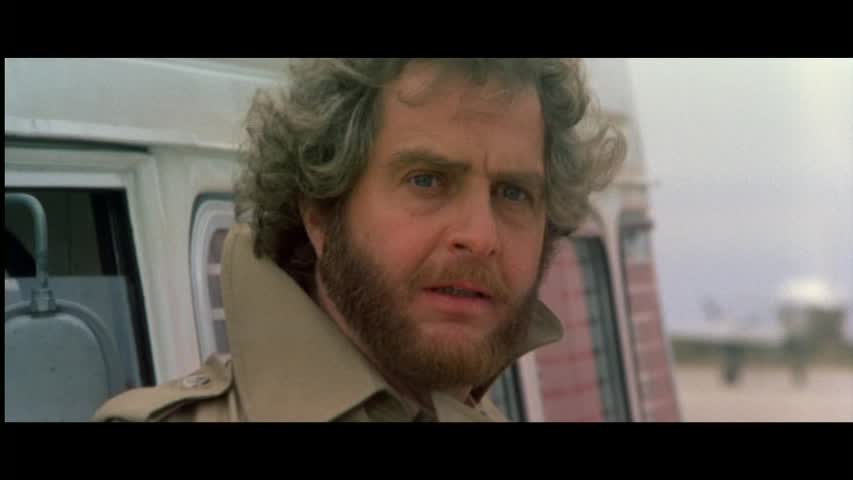
In fact, one could argue that the film's dénouement goes some way towards explaining both Stiglitz's sometimes seemingly vacant screen presence (although to be fair he does a mean army roll when jumping off a balcony, and when he throws a TV you better watch the fuck out!) and the frankly craptastic make-up effects.


Also of note (although somewhat incongruous in this particular flick) is the scene where two women are shacked up in a barricaded house. One of them creeps around with an oil lamp, projecting groovy gothic ambiance over the whole sequence. It almost feels like it's appeared out of another movie (in fact, it feels strikingly similar to the vibe that Fulci would create for a film's full duration with next year's The House by the Cemetery), but exudes such style and suspense that I've gotta give Lenzi and his DP Hans Burman their dues for it.


Last but not least, the climactic scene takes place on a frickin' roller-coaster for crying out load, so what else do you need? (To say nothing of the movie's wonderful "ending" of course....)


"I don't know what the fuck just happened to me but I am so stoked for the next movie...."
15:45 - City of the Living Dead (Lucio Fulci, 1980)

Rounding off the first half of today's viewing (and also forming a fairly solid zombie themed triple bill with the previous two movies) is our second and (owing to time constraints and much dicking around from your's truly) final feature from splatter supremo Lucio Fulci.
It begins with darkness and an ear piercing scream....followed some epic, and downright apocalyptic intro music from Fulci regular Fabio Frizzi.
We open on a fog shrouded cemetery, which we float slowly across like disembodied spirits as the credits roll past. We come across the brooding figure of Father Thomas (played by the striking looking Fabrizio Jovine), who soon hangs himself, causing all hell to quite literally break loose.

Of all of the films from Fulci's Gates of Hell trilogy, this is the one that gets me most on a visceral level, and for a while it was my favourite of the three, but House by the Cemetery has since overtaken it. The Beyond is still amazing, but the somewhat compromised final reel - with zombies added in against Fulci's wishes in order to appease the German producers - has relegated it to third place for me (although this could no doubt change in the future).

To be honest though, today I'm not getting into the movie as much as I normally do, which I would attribute to the time of day I'm watching it. The room I'm in is as dark as it can be made but I think that this one really needs to be watched at night, and in an ideal world, with the curtains open and dense mist or fog creeping around outside.... actually, I'd probably shit myself if I tried that one.... it would certainly be interesting though.... At any rate, its foreboding atmosphere seems to increase tenfold once the sun sets.

There's not a lot I can say about it based on this particular re-watch, but here's a few things I particularly dug this time round. And in the interest of brevity (seeing as I've been far from succinct so far), here's some bullet points:

- Theresa (Adelaide Aste), the master medium, has some wonderfully portentous dialogue. For example: "At this very precise moment, in some other distant town, horrendously awful things are happening, things that would shatter your imagination!".... I won't go into detail on what these hideous events she alludes to involve as you'll already be well aware if you've seen it, and if you haven't, I wouldn't want to spoil it for you....
- The only one I'll mention (and this isn't a spoiler as it's very early in the movie) is when Mary (Catriona MacColl) wakes up in a coffin after being presumed dead from fright (she sees Father Thomas hang himself during a séance) and starts trying to claw her way out. There's some damn icky shit in this movie, but strangely, it's only this moment (and it's attendant nail trauma) that makes me squirm every time.
- I love Christopher George's performance here as a cocksure, cigar smoking reporter (somewhat in the vein of Ian McCulloch in Zombie); he practically swaggers his way through the entire film and adds some greatly appreciated humour to this thoroughly morbid movie (and I mean that in a purely descriptive sense, as opposed to derogatory).
- Whilst I'm sure the movie would have looked even more amazing in 35mm, I'd argue the grainier 16mm stock they used is actually quite effective at times, especially during those wonderfully atmospheric, foggy exterior scenes.
- On a related note, the Blu-Ray I'm watching (from Arrow Video) is a treat for the eyes and ears; the 7.1 surround re-mix really adds some extra kick to Frizzi's already menacing score, and those gorgeous midnight blue gel lights really pop off the screen.... Incidentally, it always seems completely apt watching a movie with lots of blue lighting on this particular format, as we'll see with another film later in the moviethon.


Sorry, that wasn't particularly succinct either....
The original plan was to watch Inferno and The Beyond next, but time is short today and to be frank, I think that my experience watching COTLD just now has persuaded me that they'd be better placed right at the end of a moviethon and in the wee hours of the morning.... Plus, for some reason, I've got a strange urge to re-watch (drum roll please)........
17:32 - Mother of Tears (Dario Argento, 2007)

Now, some of you may be thinking "Jesus Christ, this guy really is high... he blew off Inferno to watch Mother of Tears", and to be fair to you, it's not a decision I can really justify on any other level than "this is what I'm more in the mood to watch right now". To be honest though, this movie gets unfairly maligned, no doubt due to the formidable shadow cast by its celebrated sisters, so I feel compelled to give it some love and attention, so to speak...


Probably the main reason this movie has been so poorly received by many is that it has (for the most part) a decidedly different feel to Suspiria and Inferno. This is no doubt due to many factors, but two spring immediately to mind. Firstly, it seems that by the time the nineties were rolling around, Italian horror film makers were starting to struggle due to changing times and a lack of finance; something that would continue throughout that decade and into the next. But perhaps more crucially (and forgive me if this is stating the obvious), the Dario Argento of the late seventies/early eighties is not the same filmmaker as the one who made this movie.

Admittedly, and yes somewhat disappointingly, Mother of Tears doesn't have that constant psychedelic, fever dream ambience that make the other mothers such perennial favourites of midnight movie lovers, although there are occasional flashes, the most striking example being when Asia is about to enter Mater Lachrymarum's lair for the climactic showdown.


On the plus side, what it does share with its siblings is a sustained sense of unpredictable craziness that manages to maintain itself for almost all of their collective running times. To put it another way, there are some serious "Holy Shit!" moments scattered throughout here; I don't want to give anything away in case you haven't seen it, but suffice to say, Rome be going CRAAAZZZYYY!!!

Plus, for pure watchability, I could happily put this on a near par with its predecessors (call me a heretic if you want), although time will truly tell as I've only seen it a few times, where as my viewings of the earlier two have been countless.




Now, some of you may be thinking "Jesus Christ, this guy really is high... he blew off Inferno to watch Mother of Tears", and to be fair to you, it's not a decision I can really justify on any other level than "this is what I'm more in the mood to watch right now". To be honest though, this movie gets unfairly maligned, no doubt due to the formidable shadow cast by its celebrated sisters, so I feel compelled to give it some love and attention, so to speak...

This film, like the previous one, starts with more shenanigans involving graveyards and priests who should probably know better. Yup, you've guessed it, yet again the forces of darkness are about to be unleashed upon an unsuspecting public..... And holy shit!!! this Mother really is the cruellest of the three... The first murder is easily on a par with Daniela Doria's infamous death in COTLD for its level of jaw-dropping visceral nastiness.... oh wait.... look out Asia!!! there's an evil monkey on the loose and he's got your shoes!!!


Probably the main reason this movie has been so poorly received by many is that it has (for the most part) a decidedly different feel to Suspiria and Inferno. This is no doubt due to many factors, but two spring immediately to mind. Firstly, it seems that by the time the nineties were rolling around, Italian horror film makers were starting to struggle due to changing times and a lack of finance; something that would continue throughout that decade and into the next. But perhaps more crucially (and forgive me if this is stating the obvious), the Dario Argento of the late seventies/early eighties is not the same filmmaker as the one who made this movie.

Admittedly, and yes somewhat disappointingly, Mother of Tears doesn't have that constant psychedelic, fever dream ambience that make the other mothers such perennial favourites of midnight movie lovers, although there are occasional flashes, the most striking example being when Asia is about to enter Mater Lachrymarum's lair for the climactic showdown.


On the plus side, what it does share with its siblings is a sustained sense of unpredictable craziness that manages to maintain itself for almost all of their collective running times. To put it another way, there are some serious "Holy Shit!" moments scattered throughout here; I don't want to give anything away in case you haven't seen it, but suffice to say, Rome be going CRAAAZZZYYY!!!

Plus, for pure watchability, I could happily put this on a near par with its predecessors (call me a heretic if you want), although time will truly tell as I've only seen it a few times, where as my viewings of the earlier two have been countless.

I'll say no more for now as I'd like to review this one more in depth at a later date.... Moving on, my next choice is another that wasn't part of the original schedule (if you can even call it that) but seemed like a no brainer (in more ways than one) to follow Mother of Tears. Making up the second part of this last minute 'Underrated, Argento/Argento Double Bill' is....
19:32 - Trauma (Dario Argento, 1993)

Trauma is sort of like the bastard love child of Argento's own gialli (especially Deep Red) and the American slasher movie. As you might expect then, it's both somewhat demented and more than a little derivative but hey, those are two of the most endearing traits of both sub-genres anyway so I'm not complaining. Sure, there are a couple of things in this movie that I can't really defend, but I still love it warts and all.

Aside from being a good movie to double up with Mother of Tears, the main reason I put this on now is because I'm heading out to do a gig in a couple of hours and I need something I've seen enough times that I can just leave it on in the background while I'm getting ready and not feel like I'm missing anything. As you might imagine then, I didn't take many notes for this one...

Part way through the film, and while someone is getting decapitated, my good friend (and the band's drummer) Alex arrives; confusion soon erupts as the freshly lopped off head has just delivered what in any normal world would be considered a posthumous line of dialogue. As he's not familiar with Italian horror and its wonderfully relaxed approach to realism, I give Alex a quick 101 on the subject. He soon disappears into another room to tune his drums and I continue watching the madness unfold...

For the rest of the movie, musical maestro Pino Donaggio has himself an unexpected collaborator in creating the film's soundtrack, as the intermittent sound of toms being pounded (with their pitch's occasionally shifted) wafts through from the other room. In one or two suspenseful moments this actually syncs up quite nicely; the rest of the time it's more discordant, but hell, in a movie like this it sort of works.

As with Mother of Tears (and probably all of the films in this moviethon) I'll revisit this in greater detail at a later date but before we move on I want to briefly mention what is perhaps the weirdest moment in the entire movie - the end credits scene. Constituting one of the most bizarre musical collisions I've heard this side of a Mr Bungle album, we get probably less than a minute of a reggae band performing on someone's balcony before Dario becomes more interested in their backup dancer, zooming in on her while simultaneously turning on the wind machines and bright white lights whilst Pino Donaggio's ethereal score supplants the groovy tune already being played. Yup, I don't know what it all means either (although the girl looks like she could be anorexic I suppose) but frankly I don't really care; Dario can pretty much do what he wants and I'll probably give him the benefit of the doubt.

21:30 approx - It's at this point that I must sadly put the moviethon on the back burner as Alex and I have got a gig to get to, but I've got the Blu-Ray for the final film already sat waiting in the player for when I get back in the wee hours.
The gig itself goes pretty well; it's a place we've played a few times before and one where thanks to the late starting time of the show we can guarantee most of the crowd are already wasted so they don't need much warming up.
I have to keep my concentration in check once or twice though, as this afternoon's viewing has got me on the lookout for scary Asian goth chicks and people with black gloves carrying suspicious packages. Luckily for everyone involved though, we manage to get through the gig without any blood being spilt on the dance floor; the only real casualties being some of the artists whose songs we chose to massacre....
After some quick post show drinks and the swift packing away of the gear (well, as swift as you can when negotiating drunk people while carrying speakers etc) guitarist/singer Steve and I depart the scene of our musical crimes and head homeward.
The drive back gives me the opportunity to indulge in a couple of jazz fags (that's a joint for any confused non-Brits out there) before I get back and stick the final movie on.
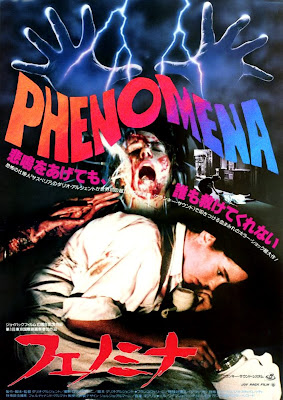
04:10 - Phenomena (Dario Argento, 1985)

This is it folks, the home stretch.... and considering the time I feel surprisingly awake, but how could I not be, I'm about to watch one of my all time favourite Italian horror films (easily top three material and depending which day you ask me on it may be my number one; at any rate it's hands down my favourite Argento and also one of my favourite films period) so I'm completely psyched to get going. Plus, it was at a similar time of day and in a comparable state of consciousness that I first encountered this strange and beautiful beast of a movie, so conditions are perfect.

Leading us into the awe-inspiring yet ominous Swiss landscape is another member of the Argento clan, Asia's elder step-sister (I think) Fiore. Apparently she didn't take to the acting game as favourably as her sibling (IMDb has only five acting credits listed for her, including an uncredited role as the Farraday Clinic's receptionist in Trauma) but she does a perfectly fine job here. As soon as she sets off into the forbidding Swiss valley and Dario's crane soars upwards to climb past some trees (with Bill Wyman and Terry Taylor's gorgeous "Valley" theme providing the perfect musical accompaniment as the wind whirls on the soundtrack), I find myself pulled through the membrane of the screen and completely sucked into Dario's mesmerising blue and breezy world.

Incidentally, and as I said earlier about City of the Living Dead, this Blu-Ray, which is also from Arrow Video, is a must for lovers of 'blue movies' (ahem). Their track record with transfers of Argento movies in HD has been fairly inconsistent, but I'd argue this is one of their better efforts, though I'm not an A/V expert or anything. I've watched it a few times now, but this particular viewing I was especially knocked out by how deep and lustrous those beautiful blues are. There are many examples of this, but one that particularly took my breath away which I hadn't noticed till now is the cool and subtle colouring of the hills in the far distances in some exterior scenes. I'll say no more on that particular subject, though I could probably go on; in fact, the amount of notes I took about the colour in this film alone no doubt speaks volumes about the stoned, sleep deprived state I was in while watching it.

It was on that kind of purely sensorial level, as opposed to narrative, that I watched the movie this time around. I know that's sort of the point with Argento, but I was leaning that way much more heavily than I usually would. And as a result, I don't really have much I can add about Phenomena for now (that I gleaned from this particular viewing that is), but rest assured, I'll be returning to drink deeper from Dario's weird and wonderful brew of insects, pissed off monkeys and telepathic, sleepwalking schoolgirls in the none too distant future.


07:05 - The End
I'm frankly amazed I made it this far, especially in retrospect. I've had a fair few moviethons since this one and I struggle to push it past four in the morning now.... I think a decade's worth of over-indulgence has finally caught up with me this year.... or, to paraphrase Danny Glover: "I'm too old for this..."... My bed beckons... To be concluded tomorrow...

Sunday 18th November 2012 - Final Thoughts and a coda of sorts...
As you might imagine, it was early afternoon by the time I finally got up today. And as is usually the case with these things, I felt almost immediately compelled (after completing a couple of pressing chores) to watch another movie. Don't ask me why (apart from it appearing on the TV at the time) but for some reason I ended up watching The Silence of the Lambs, of all things. Now, in some ways this could be seen as something of an extreme gear shift, with it being sort-of the quintessential "respectable" horror film (so much so that it seems many don't even think of it as part of the genre), whereas Phenomena, on the other hand, was never gonna win any Oscars. But who cares about awards anyway I suppose?... or as Lester Bangs more eloquently put it: "fuck those people who'd rather be watching The Best Years of Our Lives or David and Lisa. We got our own good tastes..."

Such debates aside though, I had an unexpected revelation watching Silence the day after my Italian horror marathon... that is, it would actually work quite well as a bizarro double feature with Phenomena. Sure, they are wildly different films in many ways, but they also share some striking similarities, such as the importance of insects in solving crimes, heroines with absent fathers and crazy killers with subterranean lairs. Now don't get me wrong, Silence of the Lambs is a great film (although if I had to pick I'd probably rather watch Hannibal, for sheer entertainment value at least) and one that always hooks me in a vice like grip (emotionally speaking) once I start watching it, but if I was forced to pick between the two, Phenomena would come out on top every time. To each their own of course though....


